The jawbone question
A Journey to the Centre of the EarthThe jawbone question is a scientific controversy over whether humanity existed in remote geological periods, and it supplies the historical frame for the expedition’s encounter with what appears to be a Quaternary human being. The account traces how a jawbone found at Moulin-Quignon became a disputed but influential piece of evidence, how further discoveries widened the case for human antiquity, and why the apparently preserved body in the underground cemetery astonishes even those prepared to believe that humans lived in the deep past.
The Moulin-Quignon discovery and its reception
On 28 March 1863, workers in the quarries of Moulin-Quignon near Abbeville, in France’s Somme department, uncovered a human jawbone fourteen feet beneath the soil. The find was accompanied by stone hatchets and carved flints, their surfaces colored by time with a uniform verdigris-like tint. The bones and objects together made the discovery more than an isolated fossil: they suggested human activity within the ancient deposits in which the jaw had been buried.
News spread across France, England, and Germany. Scientists associated with different learned bodies examined the evidence, and the account names Milne-Edwards and De Quatrefages among its ardent supporters. Their public defense helped make the authenticity of the jawbone a major scientific issue rather than a local quarry report. The controversy’s familiar English label, the jawbone question, captures both the concrete object at its center and the broader problem it raised: how far back in geological time could human presence be placed?
Professor Hardwigg belonged to the confident majority that accepted the find. Leading geologists in the United Kingdom, including Falconer, Buck, and Carpenter, were joined by German scholars, among whom Hardwigg is described as especially eager and enthusiastic. In the account’s presentation, the authenticity of a human fossil assigned to the Quaternary period seemed established even to many who had been skeptical. That confidence was not universal, however, and the episode is framed as a live dispute rather than a settled scientific consensus.
Disagreement over geological age
The principal opponent identified is Elie de Beaumont, a geologist who argued that the Moulin-Quignon soil belonged not to the diluvial deposits but to a much less ancient stratum. Following Cuvier on this point, he rejected the idea that human beings had lived at the same time as Quaternary animals. The quarrel therefore concerned not simply whether the jawbone was human, but which geological layer contained it and what that placement would imply about the history of humanity.
The narrative describes an extended conflict of argument and publication. Hardwigg and most other geologists held their position, disputed the opposing view, and wrote about the question until de Beaumont was left comparatively isolated. Yet the later account complicates any sense that debate ended with a clean victory: while the expedition was away from the upper world, the evidence and argument entered a new phase. The changing state of paleontological knowledge is thus part of the story’s chronology, not merely background to the subterranean journey.
Further jawbones, belonging to individuals of varied types, were subsequently found in loose grey sands in caves in France, Switzerland, and Belgium. They appeared with arms, utensils, tools, and the bones of children, adults in their prime, and old people. This wider range of remains strengthened the case for Quaternary humanity, making the Moulin-Quignon find part of a growing body of evidence rather than a single exceptional specimen.
Extending human antiquity beyond the Quaternary
The account then distinguishes the jawbone evidence from a still more radical line of argument. Remains found in Pliocene, or Tertiary, deposits were not human bones, but fossil animal shinbones and thighbones that had been regularly hollowed and sculpted. Their apparent marks of human handiwork allowed some of the more far-seeing or audacious scholars to argue that humans had existed at an even earlier date. The distinction matters: the proposed evidence for humanity in these older strata consisted of worked objects, not the direct recovery of human skeletons.
Taken together, such discoveries pushed humanity further back in geological time. The narrator explains that some geologists assigned the Pliocene an age of more than a hundred thousand years, making humans, on this account, older than the mastodon and contemporaries of the southern elephant, Elephas meridionalis. These claims are presented as part of the period’s paleontological debate, not as an unqualified statement of modern scientific fact. Their narrative function is to show how new finds repeatedly forced scholars to reconsider the depth of human history.
That background also gives the expedition’s geological observations a larger context. As the travelers pass through strata described as transitional and Silurian, the narrator watches the fossil record appear to advance from rudimentary trilobites toward more developed ancient life. The underground journey converts geological succession into a route through visible rock and fossils; the jawbone controversy supplies the contemporary intellectual question behind that progression—whether human beings, too, might belong to the farthest reaches of the record.
The underground encounter and the limit of inference
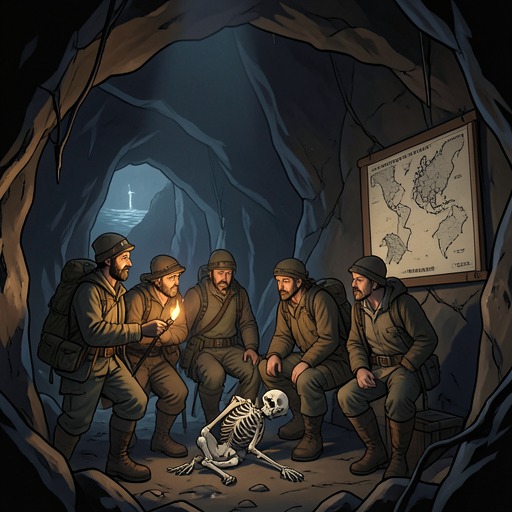
The debate becomes immediate when Professor Hardwigg advances about twenty yards and finds what the narration identifies as a specimen of the human race belonging to the Quaternary period. The discovery is described as a recognizable skull, with whole teeth, abundant hair, and stretched, parchment-like skin. Its apparent preservation raises an unresolved question for the narrator: whether an unusual soil, comparable to that of the cemetery of Saint-Michel at Bordeaux, could have preserved it for ages.
The encounter is not presented as a calm confirmation of a theory. The narrator stands mute, nearly paralyzed by awe, while Hardwigg, ordinarily talkative, is temporarily unable to speak. They raise the body and set it upright; to their excited imaginations, its hollow eyes seem to look back at them. The scene turns abstract chronology into a face-to-face confrontation with a body that appears to have survived from another age, while preserving uncertainty about how it endured and what exactly the travelers have found.
The episode therefore makes the jawbone question a hinge between public scientific controversy and private eyewitness shock. Earlier evidence had been excavated, classified, argued over, and placed in geological time; here, the explorers seem to encounter human remains directly in a subterranean world whose strata and fossils make deep time tangible. The discovery intensifies the debate without erasing its uncertainties: the explorers’ astonishment is certain, but the proposed means of preservation remains unanswered, and the account presents the historical claims as the scientific understandings of its period.